Jun 11, 2026 · TIZZLE Company · AI · Product · Business
How Crooli Approaches Practical AI
Crooli's approach to AI starts with useful outcomes, user control, clear limits, and products that prove their value in real workflows.
Read on company site ↗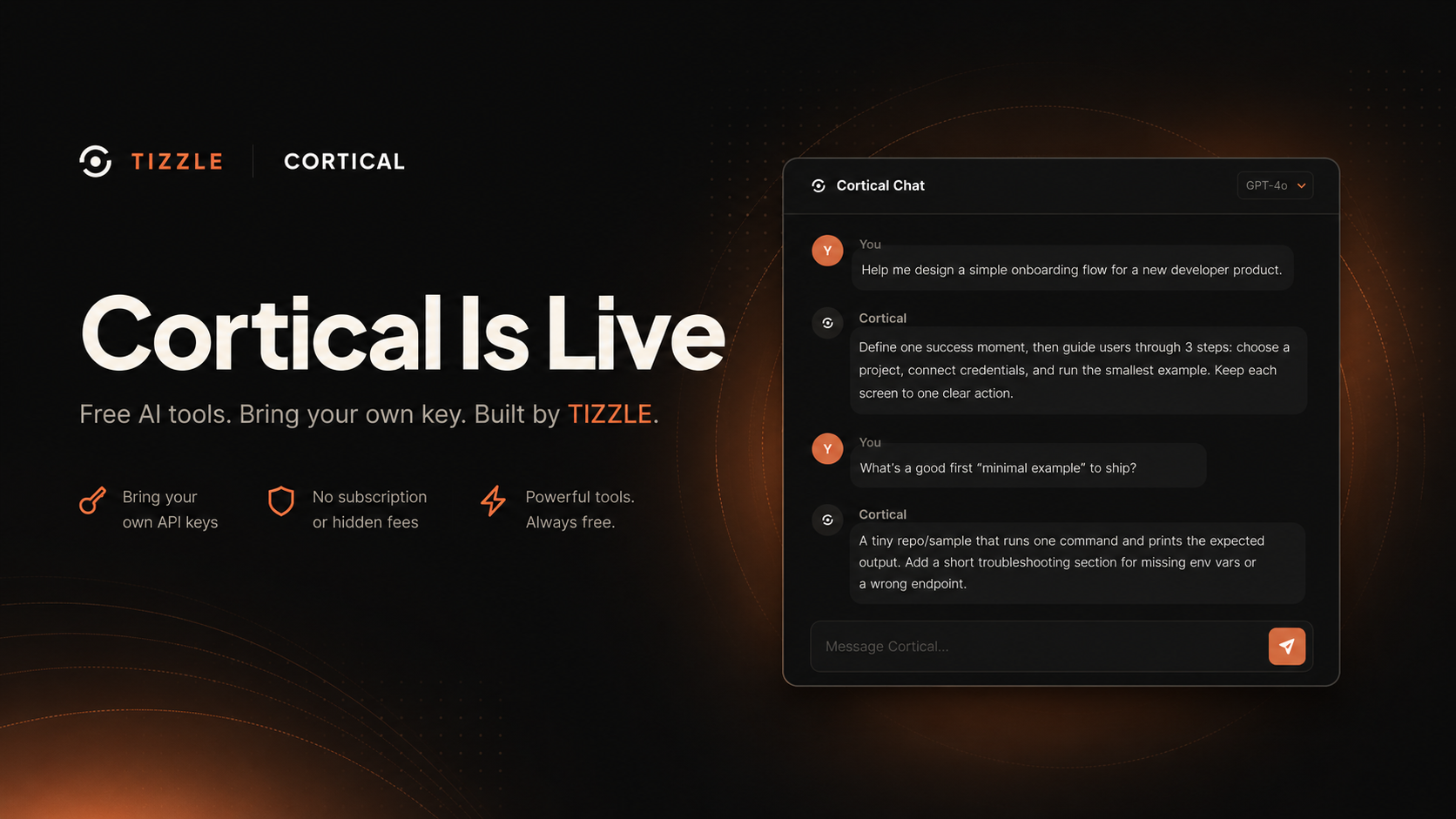
Artificial intelligence is most useful when it disappears into the work.
People should not need to adopt an entirely new operating model just to benefit from a language model, a search system, or an automation. The technology should reduce a real source of friction and leave the user with a clearer, faster, or more capable process.
That principle shapes Crooli's work across AI products, client integrations, internal tools, and Cortical.
Start with the job, not the model
An AI project can become vague very quickly. "Add AI" is not a product requirement. It does not identify a user, a task, a decision, or a measure of success.
We begin with a narrower set of questions:
- Who is doing the work?
- What are they trying to complete?
- Where does the current process slow down or break?
- What information is available?
- What must remain under human control?
- How will we know the new system is better?
This often reveals that AI should be one component inside a broader workflow rather than the entire product.
A support assistant, for example, is only useful if it can retrieve accurate company information, show where an answer came from, handle uncertainty, and route the user to a person when necessary. The chat interface is the visible part; the knowledge structure, permissions, evaluation, and fallback paths are the product.
The three areas of Crooli AI
Crooli's AI work spans three connected areas.
AI products
Cortical is the main product direction. Its current tools focus on giving users useful interfaces while allowing them to choose the underlying model provider.
The bring-your-own-key approach gives users more control over access and cost. It also keeps the value of the product focused on workflow, interface, context, and usability rather than reselling model usage behind another opaque subscription.
Applied integration
For businesses, the opportunity is usually not "an AI app." It is a better version of an existing process.
Examples include:
- searching internal knowledge in natural language
- classifying and routing incoming requests
- drafting structured responses for human review
- extracting information from documents
- summarising operational activity
- helping users navigate complex products
- identifying anomalies that deserve attention
The right solution may use a hosted model, retrieval, rules, conventional software, or a combination of all four.
Research through real use
Research becomes more useful when it is connected to products. Live tools expose practical questions about reliability, steerability, latency, cost, privacy, and interface design.
Cortical provides a place to test those questions against real workflows. The goal is not research theatre. It is to improve the control and usefulness of intelligent systems through direct product experience.
Human control is a product feature
AI output can be incomplete, inaccurate, or confidently wrong. A responsible product does not hide that limitation.
The level of human review should match the risk of the task. Generating alternative headlines is different from approving a financial decision. Summarising a public document is different from acting on private customer data.
Useful control can take several forms:
- requiring review before an action is completed
- showing the source material used for an answer
- making edits and tool calls visible
- limiting what the system is allowed to access
- giving users a clear way to undo or correct a result
- escalating uncertain cases rather than fabricating certainty
This is not friction added after the product is built. It is part of the product design.
Use the smallest reliable system
Not every AI feature needs an agent, a vector database, multiple models, and a complex orchestration layer.
Complexity should be earned by the problem. A deterministic rule is better when the decision is stable and explicit. Conventional search is better when exact matching is sufficient. A small model may be better when latency and cost matter more than broad reasoning.
We prefer the smallest system that can produce the required outcome reliably. That keeps products easier to test, explain, operate, and improve.
Evaluation before enthusiasm
An impressive demo is not the same as a dependable product.
Before an AI workflow becomes important, it needs evaluation. The exact method depends on the use case, but useful checks can include:
- accuracy against a representative set of examples
- rate of unsupported or invented answers
- response time under normal use
- cost per successful task
- user correction rate
- percentage of cases that require escalation
- performance after the underlying model changes
Evaluation should continue after launch. Model providers update their systems, company knowledge changes, and users find cases the initial test set did not include.
Privacy, permissions, and data boundaries
AI systems often become interfaces to sensitive information. That makes ordinary software engineering disciplines even more important.
Data access should follow explicit permissions. The system should receive only the context required for the task. Logs and retained conversations should have a defined purpose and retention policy. Third-party model providers should be chosen with an understanding of how data is processed.
For client work, these decisions belong in discovery and architecture, not in a final compliance pass.
Where AI helps Crooli internally
Crooli also applies AI to its own delivery process. Appropriate uses include early requirement analysis, edge-case discovery, test planning, documentation, content structure, and repetitive implementation tasks.
The purpose is not to remove judgement. It is to reserve more human attention for the parts that need it: product decisions, visual quality, architecture, security, communication, and final review.
Every output still belongs to the person responsible for shipping the work.
What practical AI looks like
Practical AI is not defined by how visible the model is. It is defined by whether the complete system improves the user's outcome.
A good AI product should be:
- clear about what it can and cannot do
- controllable by the person using it
- measured against a real task
- appropriately private and permissioned
- maintainable when providers or models change
- useful even after the novelty has worn off
That is the standard Crooli is applying to Cortical, internal systems, and client integrations.
The technology will continue to change quickly. The underlying discipline should not: understand the problem, design the full workflow, keep people in control, test what matters, and ship intelligence only where it does useful work.