Skip to contentHow We Get Clients (No Cold DMs) | TIZZLE BLOGMost people trying to get clients make one mistake:
They wait for referrals and “hope” marketing works.
We did that too.
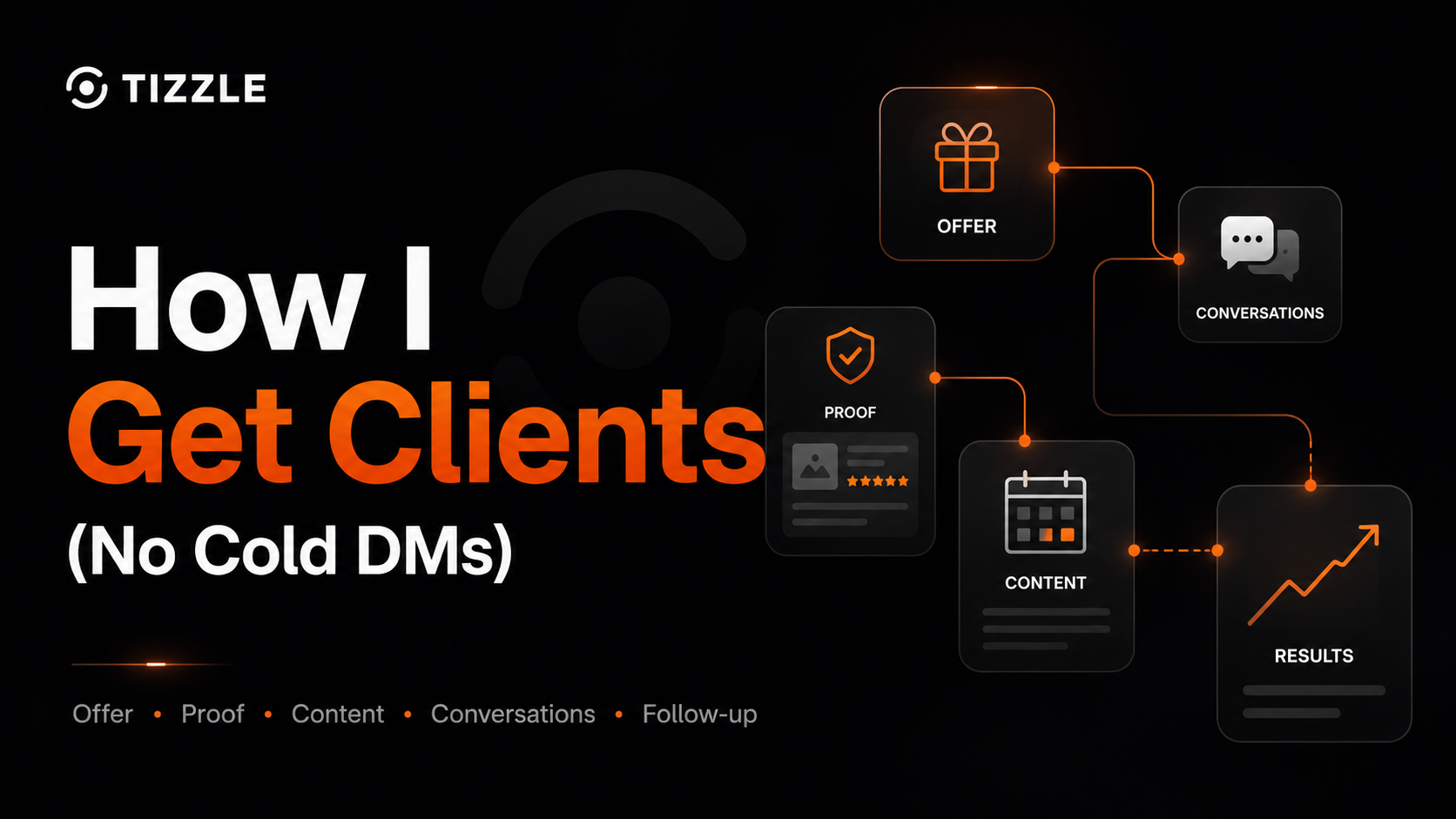
What changed everything was building a simple, repeatable client system.
Not viral content. Not spammy outreach. Just consistent execution.
In this post, we’ll show the exact framework we use to get inbound leads, start real conversations, and close good-fit clients.
1) Start with a clear offer (not a vague skill)
Clients don’t buy “a developer” or “a designer.”
They buy outcomes.
Instead of this:
Use this:
- “We help B2B SaaS founders improve demo requests with high-converting landing pages in 14 days.”
A strong offer has 3 parts:
- Who you help
- What result you create
- How fast / how simply you deliver it
If your offer is fuzzy, your pipeline will be too.
2) Build a proof stack
Before people hire you, they look for evidence.
Your proof stack should include:
- 2-3 short case studies
- Before/after metrics (even small wins)
- Screenshots or work samples
- A simple “how we work” page
Case study template:
### Client: [Type of business]
**Problem:** [What was broken]
**Approach:** [What you changed]
**Result:** [Specific measurable outcome]
No fluff. Just context, action, result.
3) Use one channel consistently for 90 days
You don’t need 5 channels. You need one channel done well.
- LinkedIn
- X/Twitter
- Dev.to
- YouTube
- Direct email
Then commit to a simple weekly cadence:
- 2 educational posts
- 1 case study post
- 10 meaningful comments on ideal-client content
- 5 direct conversations started
Consistency beats intensity.
4) Turn content into conversations
Content is top-of-funnel. Conversations close deals.
At the end of relevant posts, use a direct CTA:
“If you want us to review your [landing page/funnel/architecture], DM REVIEW and we’ll send quick feedback.”
- Clear
- Low-friction
- Useful immediately
Don’t ask for a “discovery call” too early. Offer value first.
5) Qualify fast to avoid bad-fit clients
Not every lead should become a call.
Use a short pre-call filter:
- What are you trying to improve right now?
- What happens if this problem stays unsolved?
- What timeline are you working with?
- Do you have budget allocated for this?
This saves hours and protects team capacity.
6) Run a simple sales call structure
- Context — Current situation
- Pain — What is costly right now
- Outcome — What success looks like
- Plan — Your approach in plain English
- Offer — Scope, timeline, price, next step
Keep it diagnostic, not pitchy.
Your goal: help them make a decision, not “convince” them.
7) Follow up like a professional
Most deals are won in follow-up.
Our minimum follow-up sequence:
- Day 0: Proposal + recap
- Day 2: Quick check-in
- Day 5: Answer objections / clarify scope
- Day 9: Close loop (“Should we move forward or pause?”)
Polite. Direct. No pressure.
Our weekly client pipeline checklist
- [ ] Publish 3 pieces of useful content
- [ ] Start 5 direct conversations
- [ ] Send 3 personalized audits/feedback notes
- [ ] Hold 2-4 sales calls
- [ ] Send proposals within 24 hours
- [ ] Follow up on all open deals
If you do this for 12 weeks, your pipeline won’t be empty.
Final thought
Getting clients is not luck.
- Clear offer
- Credible proof
- Consistent visibility
- Intentional conversations
- Professional follow-up
Run the system long enough, and momentum compounds.
If helpful, we can share the exact client onboarding template we use after a deal closes.