CTRL K
How TIZZLE Approaches Practical AI
Artificial intelligence is most useful when it disappears into the work.
People should not need to adopt an entirely new operating model just to benefit from a language model, a search system, or an automation. The technology should reduce a real source of friction and leave the user with a clearer, faster, or more capable process.
That principle shapes TIZZLE’s work across AI products, client integrations, internal tools, and Cortical.
Start with the job, not the model
An AI project can become vague very quickly. “Add AI” is not a product requirement. It does not identify a user, a task, a decision, or a measure of success.
We begin with a narrower set of questions:
- Who is doing the work?
- What are they trying to complete?
- Where does the current process slow down or break?
- What information is available?
- What must remain under human control?
- How will we know the new system is better?
This often reveals that AI should be one component inside a broader workflow rather than the entire product.
A support assistant, for example, is only useful if it can retrieve accurate company information, show where an answer came from, handle uncertainty, and route the user to a person when necessary. The chat interface is the visible part; the knowledge structure, permissions, evaluation, and fallback paths are the product.
The three areas of TIZZLE AI
TIZZLE’s AI work spans three connected areas.
AI products
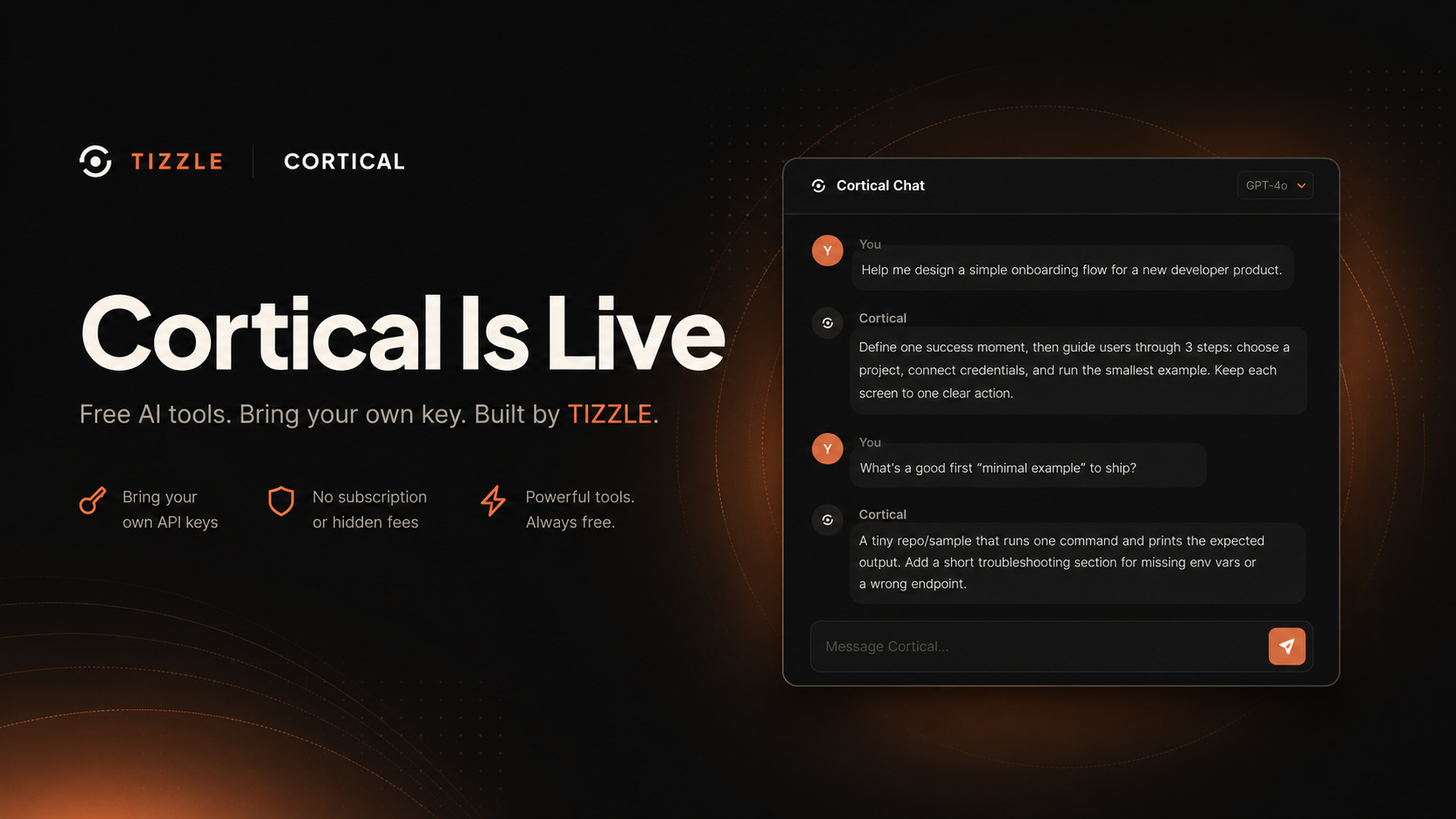
Cortical is the main product direction. Its current tools focus on giving users useful interfaces while allowing them to choose the underlying model provider.
The bring-your-own-key approach gives users more control over access and cost. It also keeps the value of the product focused on workflow, interface, context, and usability rather than reselling model usage behind another opaque subscription.
Applied integration
For businesses, the opportunity is usually not “an AI app.” It is a better version of an existing process.
Examples include:
- searching internal knowledge in natural language
- classifying and routing incoming requests
- drafting structured responses for human review
- extracting information from documents
- summarising operational activity
- helping users navigate complex products
- identifying anomalies that deserve attention
The right solution may use a hosted model, retrieval, rules, conventional software, or a combination of all four.
Research through real use
Research becomes more useful when it is connected to products. Live tools expose practical questions about reliability, steerability, latency, cost, privacy, and interface design.